A True Mother’s Day

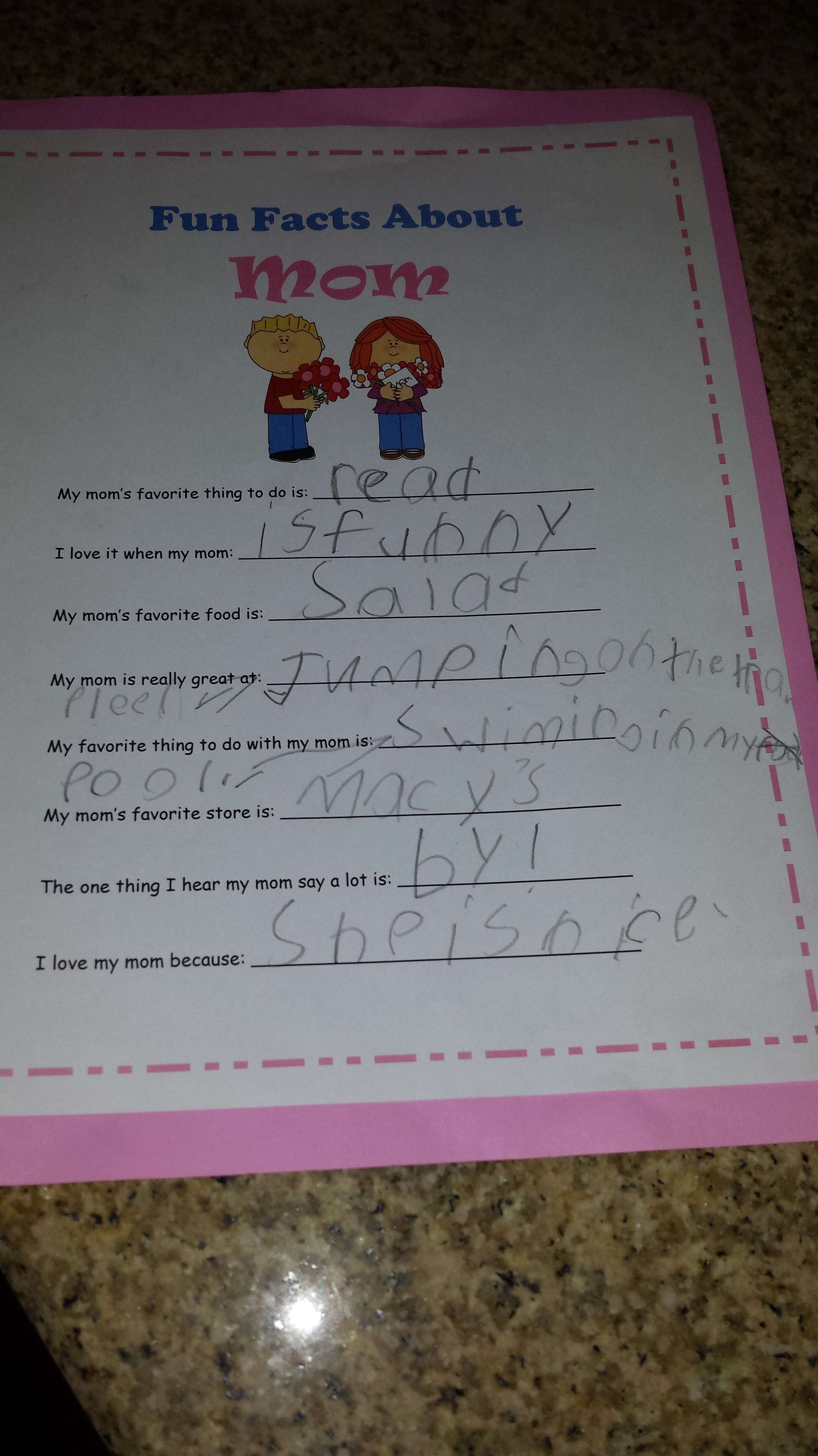
On Mother’s Day I wake up a half hour early so I can sneak out of bed before anyone gets the clever idea of bringing me breakfast and to have a moment of peace before I receive my sanctioned doses of gratitude. At 6:30 a.m., my son assured me that we can play games all day because mother’s day means getting to do whatever I want. We clearly have different definitions of what I “want.” However, after waking up with a timeline full of Facebook tributes to mom, I feel compelled to bring my “A” game. Also, I remain haunted by the All about Mom Questionnaire my son brought home from school.
20150508_170359

Number seven is a dagger to the heart. Luckily, his answering that my favorite food is salad throws the validity of form into question. I rationalize that he was probably thinking of the words he hears every morning when I drop him off to school (that’s right drop him off because I am too soft-hearted to make him ride the bus). Still, even in this context, it pushes the big flashing guilt button every working mom has.

Adding to the damning questionnaire is the history lesson of the day that Mother’s Day was created to pay homage to the great work done by women. In particular, Anna Jarvis wanted to recognize her mother Anne Reeve Jarvis, who spent her free time (a whole other concept in the 1860s) teaching women how to care for their children. Only four of her eleven children lived to be adults due to poor sanitation and lack of vaccinations at the time. She also organized “Mothers’ Friendship Day” after the Civil War, which brought together mothers and soldiers from both the Union and the Confederacy in order to “promote reconciliation.” 

I realize now that allowing my daughter to use my bath tub today was not such a large sacrifice. After all, she did bring her own bubble bath. If we learn anything about the legends of motherhood, it is that self-sacrifice is a virtue. I tried valiantly to wear the mantle through sibling spats, six-year-old male rambunctiousness (my son’s new life ambition is to be a WWE wrestler), an endless round of storytelling in a cramped indoor fort, etc. Unfortunately, I am only human.

The day ends with my daughter first “accidentally” dropping a toy in the toilet and then later an entire roll of toilet paper. For the safety of all, I explained to her that she needed to remove herself from my line of vision. The mournful sound of “It’s a hard luck life” could be heard throughout the house from behind the closed door of her bedroom.

A hallmark holiday it was not. However, it was a true mother’s day.

It’s all THATcamp

Dr. Jen NM's avatarDigiCommons

Today I experienced the collaborative, anything-can-happen wonder that is THATcamp. An “unconference” where all participants are potential presenters, THATcamp stands for The Humanities and Technology Camp. Instead of beginning with what we could potential present, we began by listing on a whiteboard what we wanted to know. Then we marked the topics we were interested in discussing. The most popular topics became the headings of the day’s six sessions.

Photo by Dr. Amy French

The first session I attended discussed engaging students in an online environment. One of my colleague discussed how she sends her online students care packages in the mail. At one point in the semester, students send her back a postcard. She does this to add an element of “touch,” which she says students crave. I would call this an affective dimension, and it’s a strategy of engagement. In my face-to-face settings, students always comment on…

View original post 277 more words

Writing a Personal Mission Statement

I always preach to my students that research should be a discovery mission. If you only set out to prove one particular fact or support one particular viewpoint, not only are you missing out on the deeper complexities of an issue but you may be missing far more interesting or applicable information for your life. I could go on about the Filter Bubble created through niche marketing, algorithms, and seeking information through social media spheres, but I have already written exhaustively about this topic in my dissertation. Today is about mission statements.

My Google search began with how to better define my blog and what I hope to do here, aside from fulfill a 30-day challenge. In my new media writing class, my students fill out rhetorical situation questionnaries about their imagined audience, their topic stance, etc. However, I was interested in finding something more like a mission statement. What I found was a New York Times blog about creating a personal mission statement. Tara Parker-Pope quotes Stephen Covey, who refers to a personal mission statement in 7 Habits of Highly Successful People, as “defining the personal, moral and ethical guidelines within which you can most happily express and fulfill yourself.”

Parker-Pope then lists the common questions asked within the Corporate Athlete Program. I think the questions will be a great warm up to my challenge/habit driven semester. So to prepare, I will answer the questions given myself.

■ How do you want to be remembered?

I want to be remembered for making a difference and changing lives, whether it be through my teaching, writing, altruistic acts, or parenting.

■ How do you want people to describe you?

Big-hearted, humorous, inspiring, and creative.

■ Who do you want to be?

I want to be someone who lives up to my full potential and fulfills the expectations of both myself and of the people in my life.

■ Who or what matters most to you?

My family matters the most.

■ What are your deepest values?

My deepest values mirror my previous answers. I value purpose-driven work, kindness, personal expression, and laughter.

■ How would you define success in your life?

Success is making the world a better place through your decisions and actions.

■ What makes your life really worth living?

Making others feel good, empowered, inspired, and loved.

I think if I use this for my opening class I would have students choose three that they can write a full paragraph (five or more sentences) about. The questions overlap a bit, so I do not think it is necessary to answer them all, but it is still a good exercise. These questions would also work well for brainstorming This I Believe essays.

I thought I would escape the classroom with this blog. Instead, I took down the walls.

Work and Self Worth

In my second day off between semesters, fresh from a retirement party, I cannot help but think of the role work plays in our sense of worth. I found myself revisiting and playing with a poem I started about my father, who believes fervently in a hard day’s work and told me often when I did not want to do a task, “Think about how good you will feel when it is done.” The underlying message being our value comes from that which we do. I’ve lately come to classify him as an existential Catholic who believes we insert ourselves into the world first by baptism and then by deed.

We stood into the wind, already sweating underneath our dusty caps,

socks staining against the dirt gathered in the bottom of our sneakers.

The bean leaves ripple, showing their pale underbelly,

as the spindles whip shapes into the sky

My father grips a hoe with his big knuckled, turgid veined fist,

hands it to me and tells me where to begin.

“Think about how good you will feel when it is done.”

We crack the topsoil and sink our footprints into the loam,

Walking miles, scouring, our heads pendulum swinging side to side

I pull two-handed the embedded ragweeds, velvetleafs

We shake the clumps of dirt from their greedy roots

Until the soil sticks to our slick forearms, embeds under fingernails,

clings to the hair of our nostrils, and grits between my teeth.

“Think about how good you will feel when it is done.”

The lesson slides down my throat, as I tip the icy thermos,

lifts perspired threads of hair and fabric as I lean

into the rushing air from the back of the truck bed

and think of the crisp line formations of the crops

My 30-day Blogging Challenge

“We are what we repeatedly do.” – Aristotle

“Could the young but realize how soon they will become mere walking bundles of habits, they would give more heed to their conduct while in the plastic state.” – William James

How long it takes for something to be a habit is a debated topic and is often dependent on the difficulty of the habit and the individual. Psychologist Jeremy Dean discovered the easy tasks, such as drinking a glass of water in the morning, could become a habit after 21 days. Health psychologist and researcher Phillippa Lally conducted a study, which found the average numbers of days needed to develop a habit to be 66 days (however, the range among study participants was 18-254 days). In motivational and fitness sites, the magic number is often 30. An array of 30-day challenges are just a Google search away.

I incorporated the concept of a 30-day challenge into my writing classes for the first time this past winter semester. The results were inspiring and (unless students were blowing sunshine up my patooty in their final reflections) life-changing. Students lost weight, conducted physical therapy, pursued acts of kindness, and most importantly learned about themselves within the process. Yes, there were failures, students who were too ambitious, goals that were not clearly enough defined, and pursuits that did not have enough intrinsic value to hold students motivations.

I conducted my own small challenges – small because I realized the enormity of my semester obligations, yet significant enough to alter my mindset and body. First, I committed to plank for at least a minute a day. I liked this challenge because it reminded me that just because I cannot get to the gym for an hour it does not mean that I should do nothing. Little bursts of activity make a difference. While I never progressed beyond the minute plank, I did see some more definition in my abs and overall was more conscious of my body.

My second challenge was to write in a journal every day. The benefit of journaling is that it makes you reflect and sort out feelings and issues, which can lead to better understanding of yourself or help you solve problems. However, as a deeply reflective person (i.e. debilitatingly shy introvert), I did not feel the need to get further in touch with my feelings. The benefits I found were that it helped me take a moment to appreciate what was happening in the lives of my children and perhaps let off a little steam.

Now, with my lighter spring load, I am ready to level up to more time-intensive health pursuits. I am also switching from journaling to blogging. I feel this will help me better sort out and deal with the issues of life because I can bring in research, will need to consider an audience, and be pressured due to the public nature to write more thoughtfully. This will also help me teach the 30-day challenge in more depth and perhaps enter the field of life experiments.

Emptying the “Cup of Sorrow”

In my benign witching days of Ouija Boards, Psychics, and Tarot Cards, I remember reading a palmistry book and examining the “mounts” of my hand. All seemed pronounced: jupiter, saturn, mercury, neptune, mars, and luna (poor Uranus does not get a mount). The book called the lowland of my palm “the cup of sorrows,” as I was pulled by so many competing forces.

Now, I cannot say for sure that the “cup of sorrow” exists in the palm of my hand. For one, not even a rigorous Google search can find evidence of this being a condition discussed in palmistry. And two, it’s questionable whether one’s life determination can be found in the physical characteristics of their hands. Now what they do with those hands is a whole other story…

hand

However, I do believe in the harm of competing forces and have felt myself sucked low by uncertainty, stress, and guilt. We only have a finite amount of time, attention, and energy, which is the bane of the digital age — endless information, restricted time.

I chose the blog name “big-eyed girls” because it is much more upbeat than “cup of sorrows” and instead of drowning in the flurry of obligations, goals, and information we are taking it all in. These posts are my captures; this site the little nest I am building.